 Régys Borges da SilveiraBooks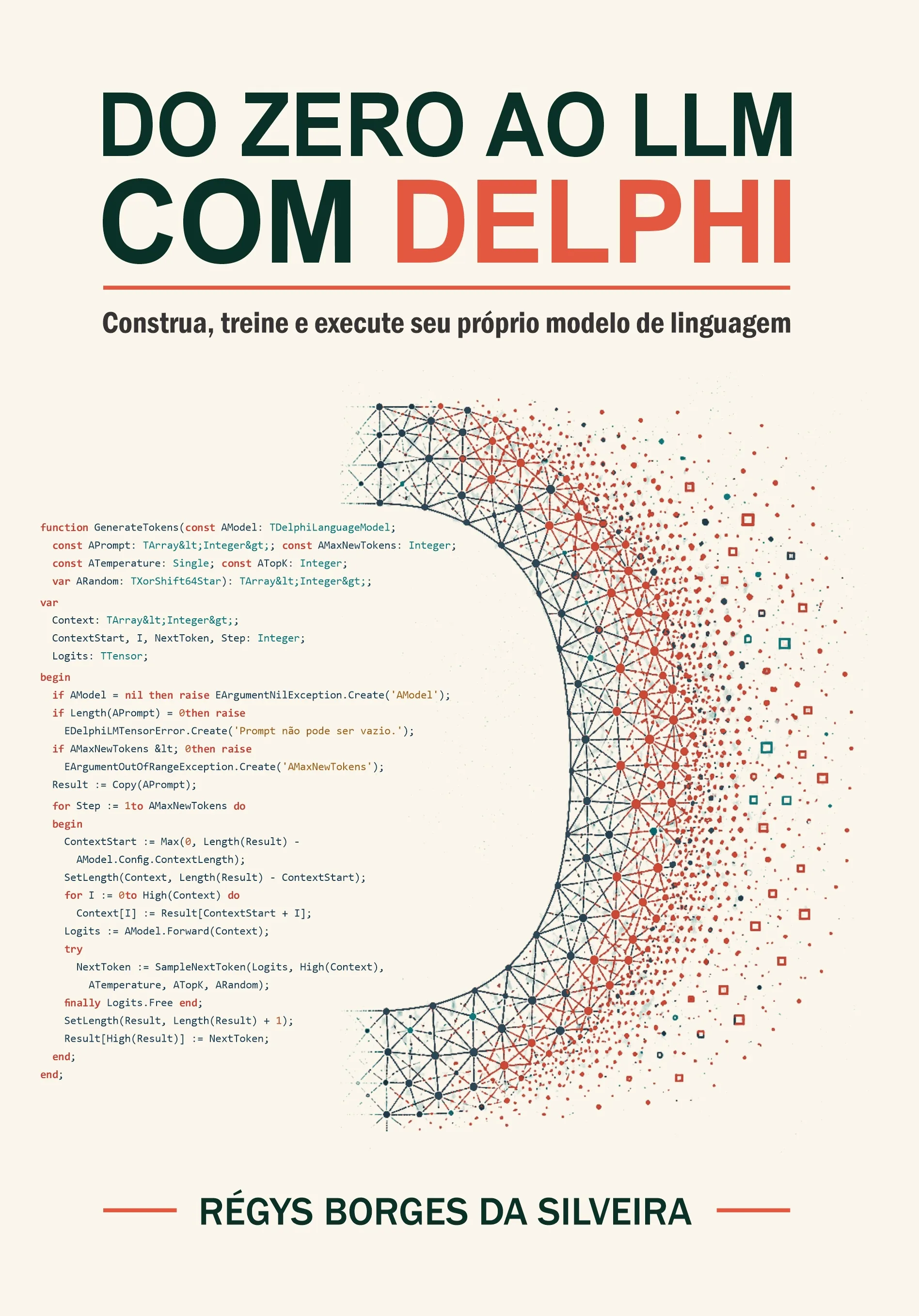
Delphi and Artificial Intelligence
You have used a language model. Now discover how it learns.
From Zero to an LLM with Delphi
Build, train, and run your own language model
Open the black box of language models by building, training, and running a small educational LLM in Delphi 13.
Print edition availableBuy the print bookRead on paper, ready to consult and keep close.R$ 147,95Buy on UICLAP →Buy on KindleAlso included with Kindle Unlimited
Prices checked on 11/10/2026. Shipping is set by the store.
★ Review this bookThis book is currently available in Brazilian Portuguese.
About the book
A complete view of the book.
From Zero to an LLM with Delphi opens the black box of language models by building a small educational laboratory from beginning to end. Readers follow the path that turns text into tokens, vectors, and tensors, measures error, calculates gradients, and adjusts parameters until a network can generate new sequences.
The mathematics begins with small examples before becoming Object Pascal and Delphi 13 code. Without relying on Python or external services, the book implements linear layers, causal attention, multiple heads, and Transformer blocks, followed by training, checkpoints, and token-by-token generation. The goal is to understand the mechanism, its limits, and the decisions hidden behind a ready-made API.
The challenge
Does this situation sound familiar?
Language models usually arrive as ready-made services: a request goes in, a response comes out, and almost the entire mechanism remains hidden. Calling an API does not reveal how text becomes numbers, how patterns are learned, or how each new token is selected.
The book’s approach
Understand the model by implementing its operations.
Build the entire path in Delphi 13—from corpus and tokenizer to tensors, neural networks, gradients, causal attention, and Transformer blocks. The mathematics begins with small examples, and every concept receives a testable Object Pascal implementation.
“Understanding a language model begins when its operations stop being invisible.”
By the end of the book, you will be able to:
✓Turn text into tokens, vectors, and tensors
✓Implement linear layers and a neural network
✓Understand loss, gradients, and optimization
✓Build multi-head causal attention
✓Assemble and train a small Transformer
✓Save checkpoints and generate text token by token
Questions that guide the reading
Answers begin with the right questions.
Questions explored through context, criteria, and examples.
What does a neural network adjust when it learns?
How does attention decide which positions to observe?
How does a causal Transformer generate text token by token?
Inside the book
A structured journey that helps you move forward.
Concepts and applications presented in a coherent sequence.
Corpus and tokenization
Prepare a corpus and build the vocabulary that turns text into numerical sequences.
Vectors, matrices, and tensors
Implement the mathematical structures underlying model operations.
Neural networks and loss
Build layers, activations, and a loss function capable of measuring error.
Gradients and optimization
Calculate derivatives, propagate gradients, and adjust parameters during learning.
Attention and Transformers
Build causal attention, multiple heads, and the central Transformer block.
Training and generation
Train the model, save checkpoints, and generate tokens while examining results and limitations.
What makes this book different
Depth to understand. Clarity to keep moving forward.
A language model built from start to finish in Delphi 13
Mathematics explained with small numbers before code
An implementation using only Object Pascal and the RTL
Testable code with honest discussion of laboratory limits
Who this book is for
Find your place in this book.
Delphi developers, architects, and professionals who want to understand language models from the inside.
✓ Delphi and Object Pascal developers✓ Programmers without prior AI training✓ Architects and technical leaders✓ Professionals who want to move beyond APIs
Before you begin
What you need to benefit from the book
✓Intermediate experience with Delphi or Object Pascal
✓No prior data science or machine learning background is required
An informed choice
This may not be the right book if…
—Readers interested only in consuming commercial model APIs
—Readers expecting to build a ChatGPT competitor in a few pages
Beyond this book
More reading. New conversations.
Explore the free guide collection and follow the books on Instagram, at your own pace.
Free guidesNo registration



One question.
A place to start reading.
123 free guides across nine pathways on rights, money, technology and public life: short reads with examples and sources to explore.
Choose a guide
Read online or download a free PDF. Guides are in Portuguese.
Books on Instagram
@livrosregysBooks by Régys


Between reads,
the ideas keep coming.
Thought-provoking excerpts, book news and a look behind what I am preparing. Discover your next idea there.
Explore the Instagram profile
@livrosregys · Opens a new tab. Posts are in Portuguese.
Book readers
Experiences from readers.
The first reviews will appear here after moderation.
Have you read it?
Share your reading experience.
After confirming your email, your review will be moderated before publication. Your email will never be displayed.
Continue the conversation
Receive resources and updates about From Zero to an LLM with Delphi.
Sign up for content, samples, and new resources related to the book.
Choose your edition
Continue your journey with the complete book.
Build, train, and run your own language model
Prices checked on 11/10/2026. Shipping is set by the store.
Print edition ISBN: 978-65-02-32159-1Keep reading
Other books for your journey
Delphi and AI
SDD in Delphi
Put specifications at the center and use AI with greater clarity, control, and technical quality.
Explore →
Software Engineering
Delphi Alive
Restore your ability to evolve Delphi systems through small, verifiable, and reversible changes.
Explore →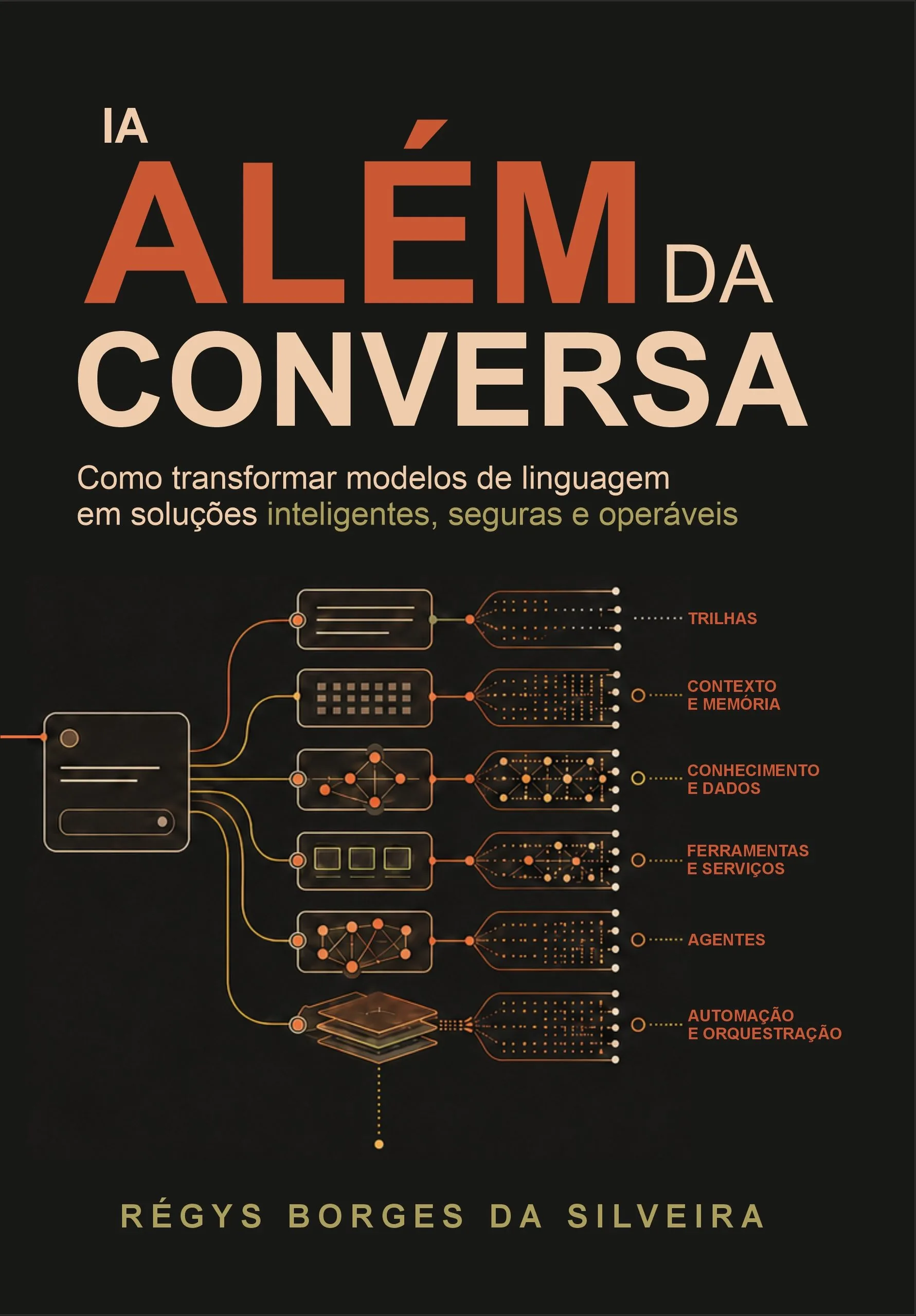
AI Architecture
AI Beyond the Conversation
Move beyond prompting and design AI solutions that can operate reliably in the real world.
Explore →