 Régys Borges da SilveiraBooks
Relationships & Dialogue
Can we stay close when we think differently?
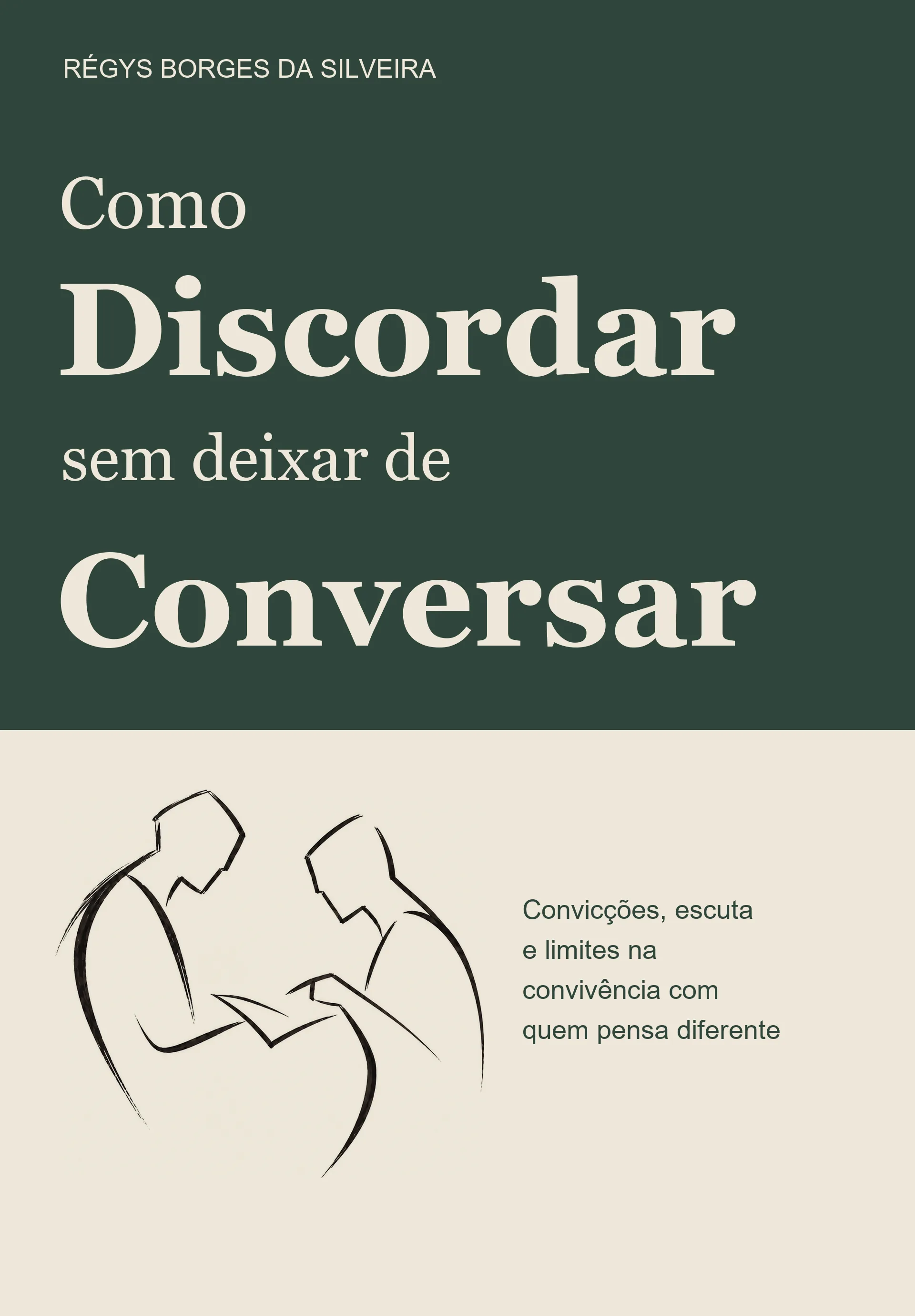
How to Disagree Without Ending the Conversation
Convictions, listening, and boundaries in living with people who think differently
Understand what makes disagreement difficult and explore ways to speak, listen, and consider the boundaries of a relationship — even when differences remain.
Notify me when it is available
This book is being prepared in Brazilian Portuguese.
About the book
A complete view of the book.
Some conversations change their subject without anyone noticing. An unfinished task becomes proof of consideration; criticism of a proposal is heard as criticism of the person. How to Disagree Without Ending the Conversation starts from these situations to examine relationships between people who reach different conclusions and must decide what to do with their differences.
Across five parts and sixteen chapters, research and reflection meet three fictional settings: a family, two friends, and a workplace team. Their stories allow readers to follow what was said, what remained an assumption, and what fulfilling a commitment actually changes. Facts, values, identity, listening, and reconsidering a position appear alongside the conditions under which each person can participate.
This is not about learning phrases to win arguments or guarantee someone else's reaction. Partial agreements, repair, pauses, and changes in closeness are possibilities to consider. Respecting someone does not make all claims equally supported, nor oblige anyone to endure humiliation, coercion, or threats.
The challenge
Does this situation sound familiar?
A conversation about chores turns into a test of affection. An objection to a deadline is taken as a lack of commitment. Among friends, a difference in belief begins to overshadow their shared history. How can we discuss what matters when disagreement already feels like a judgment of who we are?
The book’s approach
Discover what can still be discussed — and recognize the boundaries.
The book follows what happens before, during, and after a disagreement. It distinguishes facts, values, and interests; examines identity and belonging; and considers how to offer reasons, listen to objections, reconsider a position, and reach possible agreements. Continuing is not an obligation: power, reciprocity, and the freedom to decline are part of the reflection.
“A difference can remain without making anyone's dignity depend on agreement.”
By the end of the book, you will be able to:
✓Notice when criticism of an idea becomes a judgment of a person
✓Distinguish facts, values, interests, and assumptions about others
✓Offer reasons and ask questions more clearly
✓Recognize a valid point and reconsider a position without staging a defeat
✓Consider power when deciding to continue, pause, or end a conversation
✓Distinguish partial agreement, repair, and actual changes in conduct
Questions that guide the reading
Answers begin with the right questions.
Questions explored through context, criteria, and examples.
How can we listen without abandoning convictions or accepting every claim?
What changes when not everyone can disagree or leave on equal terms?
What can we still build when consensus does not come?
Inside the book
A structured journey that helps you move forward.
Concepts and applications presented in a coherent sequence.
When differences become personal
Examine what a position represents to the person holding it and how we interpret the intentions of those who disagree.
What the disagreement is about
Separate claims, sources, values, and interests to understand what needs evidence and what involves difficult choices.
Speaking, asking, and listening
Consider the moment to respond, how to ask questions and present reasons, and the possibility of reconsidering part of a position.
Power and the limits of conversation
Recognize unequal power, public exposure, and the freedom to decline. Better conversation does not replace protection or appropriate support.
Repair and feasible commitments
Distinguish acknowledging an offense, repairing consequences, and taking responsibility, without demanding forgiveness in return.
Living with differences that remain
Follow limited agreements, commitments, and changing relationships without assuming every disagreement will end in consensus.
Content in preparation
Planned book structure
Explore the 5 parts and 16 planned chapters. Titles may be refined during editorial review.
View chapters16 chapters
Part I — When disagreement becomes personal
- The conversation that changed its subject
- What we defend when we defend an idea
- The stories we tell about others
Part II — Understanding disagreement
- What are we disagreeing about?
- Facts, sources, and standards of evidence
- Values, interests, and difficult choices
Part III — Speaking and listening during disagreement
- Before responding
- Questions that open up space
- Saying what we think clearly
- Recognizing a point and reconsidering a position
Part IV — Recognizing boundaries
- Not every conversation takes place between equals
- When to pause and when to end
- Disagreeing in front of an audience
Part V — Living together after the conversation
- Repairing what happened
- Possible agreements, differences that remain
- The next conversation
What makes this book different
Depth to understand. Clarity to keep moving forward.
Three fictional settings followed across chapters, never presented as evidence of effectiveness
Research discussed with attention to its context and the limits of its conclusions
Convictions, listening, and power relations considered together
A glossary and index for revisiting concepts and specific difficulties
Who this book is for
Find your place in this book.
People facing disagreements in families, friendships, workplaces, and messaging groups.
✓ Readers seeking to understand disagreements in close relationships✓ People living with differences in beliefs, priorities, or values✓ Professionals and leaders discussing decisions and working conditions✓ Teachers and readers interested in listening, relationships, and responsibility
Before you begin
What you need to benefit from the book
✓No specialized background or prior reading of another book by the author is required
✓Concepts are explained through everyday situations, with attention to their conditions and limits
An informed choice
This may not be the right book if…
—Readers seeking foolproof phrases to persuade, manipulate, or win arguments
—Readers expecting a therapeutic protocol or an obligation to preserve every relationship
Beyond this book
More reading. New conversations.
Explore the free guide collection and follow the books on Instagram, at your own pace.
Free guidesNo registration



One question.
A place to start reading.
142 free guides across nine pathways on rights, money, technology and public life: short reads with examples and sources to explore.
Choose a guide
Read online or download a free PDF. Guides are in Portuguese.
Books on Instagram
@livrosregysBooks by Régys


Between reads,
the ideas keep coming.
Thought-provoking excerpts, book news and a look behind what I am preparing. Discover your next idea there.
Explore the Instagram profile
@livrosregys · Opens a new tab. Posts are in Portuguese.
Upcoming release
Receive resources and updates about How to Disagree Without Ending the Conversation.
Sign up for content, samples, and new resources related to the book.
Upcoming release
How to Disagree Without Ending the Conversation is coming soon.
Official links will be published as soon as the editions are available.
Keep reading
Other books for your journey

History & Belonging
The Roots of Our Sides
Discover the paths that connect people to ideas and how much of a life story remains outside a label.
Explore →
Leadership and AI
Amplified Leadership
Use technology to reveal the right problem and restore attention to work that requires human judgment.
Explore →
Vocational education
Why Do They Leave?
Understand the journeys behind the empty chair and recognize signs while the student is still present.
Explore →