 Régys Borges da SilveiraBooks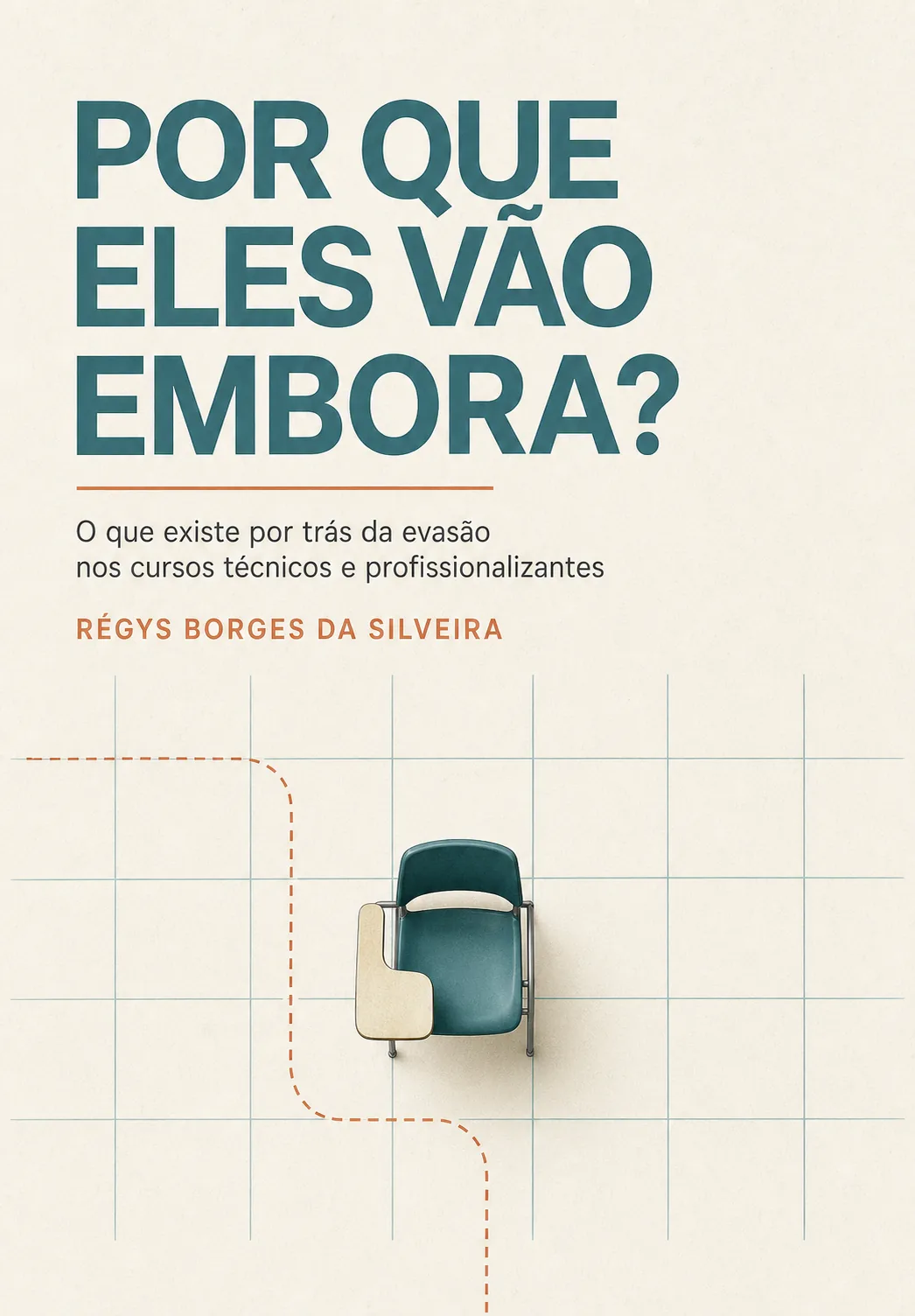
Vocational education
The empty chair is the visible result. The journey began earlier.
Why Do They Leave?
What lies behind dropout in technical and vocational education
Understand the journeys behind the empty chair and recognize signs while the student is still present.
Print edition availableBuy the print bookRead on paper, ready to consult and keep close.R$ 76,04Buy on UICLAP →Buy on KindleAlso included with Kindle Unlimited
Prices checked on 28/09/2026. Shipping is set by the store.
★ Review this bookThis book is currently available in Brazilian Portuguese.
About the book
A complete view of the book.
An empty chair is only the visible result of a journey. Why Do They Leave? investigates what happened before it: the expectations students brought, the experiences they had, the signs that emerged, and the paths that opened afterward.
Across 15 chapters and a workbook with 15 practical tools, the book distinguishes dropout, withdrawal, persistence, retention, and mobility; examines work, learning, belonging, material conditions, and institutional organization; and helps vocational educators interpret evidence and act without ready-made formulas or blame. Editable supporting templates are available in Portuguese.
The challenge
Does this situation sound familiar?
When a student stops attending, saying that they quit seems to settle the matter. That explanation hides expectations, material conditions, learning experiences, belonging, work, earlier signs, and changes of direction.
The book’s approach
Look at the journey before explaining the empty chair.
Learn to distinguish dropout, withdrawal, non-completion, retention, mobility, and success; reconstruct journeys, interpret indicators rigorously, and turn evidence into possible decisions without searching for a single culprit.
“Understanding why someone leaves begins by observing what happened while that person was still present.”
By the end of the book, you will be able to:
✓Distinguish concepts that indicators often mix together
✓Reconstruct the journey preceding the empty chair
✓Recognize signs, risk factors, and protective factors
✓Interpret data without turning correlation into cause
✓Examine learning, belonging, work, and material conditions
✓Plan more conscious educational and institutional responses
Questions that guide the reading
Answers begin with the right questions.
Questions explored through context, criteria, and examples.
Does every departure represent failure, or are there different journeys?
Which signs can be noticed while the student is still present?
What lies within the reach of teachers, institutions, and public policy?
Inside the book
A structured journey that helps you move forward.
Concepts and applications presented in a coherent sequence.
Changes in vocational education
Begin with the empty chair to understand how work, vocational education, and students have changed.
Dropout concepts and evidence
Distinguish dropout, withdrawal, mobility, retention, completion, and success before interpreting results.
Journeys and earlier signs
Follow the journey from choosing a course through the friction, signs, and decisions that precede leaving.
Learning and belonging
Observe how teachers, learning, and belonging can protect or weaken persistence.
Work and material conditions
Consider students who study in order to work and work in order to study, without oversimplifying material conditions.
Persistence and institutional action
Examine the institution itself, improve indicators, and turn knowledge into possibilities for persistence.
What makes this book different
Depth to understand. Clarity to keep moving forward.
Research and data translated into useful everyday questions
Conceptual rigor without inaccessible language
A workbook with 15 practical tools and editable templates in Portuguese
A humane, non-blaming reading of student journeys
Who this book is for
Find your place in this book.
Teachers, instructors, educational teams, and leaders in technical and vocational education.
✓ Teachers and instructors in technical and vocational courses✓ Pedagogical supervisors, coordinators, and advisers✓ Teams responsible for student persistence and success✓ Leaders of public and private vocational institutions
Before you begin
What you need to benefit from the book
✓No training in research or educational management is required
✓Experience or interest in vocational education helps connect the cases to practice
An informed choice
This may not be the right book if…
—Readers seeking a formula that can prevent every departure
—Readers who want to assign dropout to one cause or one culprit
Beyond this book
More reading. New conversations.
Explore the free guide collection and follow the books on Instagram, at your own pace.
Free guidesNo registration



One question.
A place to start reading.
123 free guides across nine pathways on rights, money, technology and public life: short reads with examples and sources to explore.
2 guides to explore this subject
 Educação pública: acesso, aprendizagem e responsabilidades
 Access and learning as context for understanding student retention.
 Igualdade e discriminação: como reconhecer barreiras
 Recognising barriers that affect participation.
Independent free readings, not a sample of this book. Guides are in Portuguese.
Choose a guide
Read online or download a free PDF. Guides are in Portuguese.
Books on Instagram
@livrosregysBooks by Régys


Between reads,
the ideas keep coming.
Thought-provoking excerpts, book news and a look behind what I am preparing. Discover your next idea there.
Explore the Instagram profile
@livrosregys · Opens a new tab. Posts are in Portuguese.
Book readers
Experiences from readers.
The first reviews will appear here after moderation.
Have you read it?
Share your reading experience.
After confirming your email, your review will be moderated before publication. Your email will never be displayed.
Continue the conversation
Receive resources and updates about Why Do They Leave?.
Sign up for content, samples, and new resources related to the book.
Choose your edition
Continue your journey with the complete book.
What lies behind dropout in technical and vocational education
Prices checked on 28/09/2026. Shipping is set by the store.
Print edition ISBN: 978-65-02-31892-8Keep reading
Other books for your journey

Education & Learning
From Theory to the Next Lesson
Understand what each student demonstrates and explore ways to plan, explain, offer support, and adjust your next lesson.
Explore →
Education and AI
Between the Blackboard and the Prompt
Bring AI into education while preserving the teacher's authorship, judgment, and responsibility.
Explore →
Leadership and AI
Amplified Leadership
Use technology to reveal the right problem and restore attention to work that requires human judgment.
Explore →